Tuesday, May 14, 2013

Welcome Dr. Robert Dreibelbis!


The OU WaTER Center welcomes its newest faculty member, Dr. Robert Dreibelbis, PhD (International Health, Johns Hopkins Bloomberg School of Public Health).  Consistent with our holistic approach to development, Dr. Dreibelbis will have a joint appointment between the Schools of Anthropology and Civil Engineering and Environmental Science (CEES). His position will add to the rich collaborations already underway among researchers in anthropology, business, and environmental engineering and science
 
Robert Dreibelbis brings much developing country experience with him to the WaTER Center and to the University of Oklahoma.
The focus of Dr. Dreibelbis's work has been on the social and behavioral aspects of interventions in developing countries.  As a researcher for Johns Hopkins School of Public Health (JHSPH) and the Center for Global Safe Water, Dr. Dreibelbis has been instrumental in spearheading projects and research that connect technology and behavior.  His research interests include ecological sanitation technologies, social marketing approaches of sanitation services, behavioral change strategies relating to hygiene interventions, and school-based sanitation technologies.   
With a passion for teaching and mentoring, Robert draws on a multi-disciplinary background that reflects engineering, epidemiology, microbiology, anthropology, and political science, complimenting his perspective with statistical, survey and qualitative methods of training.  His work has taken him to Kenya, Nepal, Bangladesh, and Peru. He continues to collaborate on exciting work with colleagues at JHSPH and Emory University. He begins work at OU in August of this year.

Visit from Lehigh's Dr. Arup SenGupta

Dr. Arup K. SenGupta of LeHigh University was on campus on Friday, April 12,  to lead a seminar and meet with students and faculty about his research for adsorption of geogenic contaminants. His passion for bettering the lives of the needy in the developing world is not only expressed in his research, but also in the non-profit that he founded, The Tagore-SenGupta Foundation. Award and prize money that is received from research recognition is generously given to this Foundation to fund its charitable work. 


An adsorption system in Cambodia reduces arsenic concentration from >600 ppb to 5 ppb

As the P.C. Rossin Professor in both the Departments of Civil and Environmental and Chemical Engineering, Dr. SenGupta applies fundamentals of ion exchange science and physical chemistry to develop sustainable environmental processes and materials, from sorbents to hybrid materials to membrane processes. To this end, Dr. SenGupta and colleagues have developed and commercialized an arsenic-selective hybrid nanosorbent, referred to as hybrid anion exchanger or HAIX, which is robust, mechanically strong and reusable. The HAIX material is now in use in five different countries and currently provides arsenic-safe water to over one million people in both the developed and the developing world.


Dr. Arup SenGupta is currently Professor at Lehigh University in Pennsylvania, USA
Recently, anion exchangers dispersed with zirconium oxide nanoparticles have been synthesized and the new sorbent materials are robust, reusable and exhibit higher fluoride removal capacity that others currently in use. Field scale trials are currently being planned. 
 
An operating arsenic removal system in India, circa 2006
Research such as his show that extra-ordinary opportunities lie ahead in transforming arsenic- and fluoride-inflicted water crisis into sustainable solutions in impoverished regions of the world. Information about Dr. SenGupta's Foundation can be found here


Update on the Fall Conference

The 2013 International WaTER Conference is already shaping up to be a huge success! Oral and poster abstracts are being reviewed and sessions are being formed for a variety of presentation topics, including: market-based solutions, capacity-building in the WASH sector, groundwater and well drilling challenges, geogenic contamination and mitigation, climate change impacts on water resources, role and experience of NGOs, social / behavioral change and assessment, and service-learning projects in developing regions. Participants are expected to attend from at least 15 developing nations, and will share with us their research, experience and rich culture. 
 
One of the scores of entries submitted in 2012 K12 student art and poster competition

This year's Conference (September 23-25, 2013) will be held at the NCED Conference Center and Hotel, the largest hotel in Oklahoma. Among its many amenities are on-site dining, salon and spa services, and a 60,000 square-foot fitness center (open 24 hours) that boasts a state-of-the-art weight room, basketball and volleyball courts, indoor and outdoor tracks, and aerobics. Because the hotel and Conference sessions are all in the same venue, participants will have ample opportunity to network with their peers, arrange association meetings with members, or gather informally at the outdoor courtyard in the center of the Conference space. 


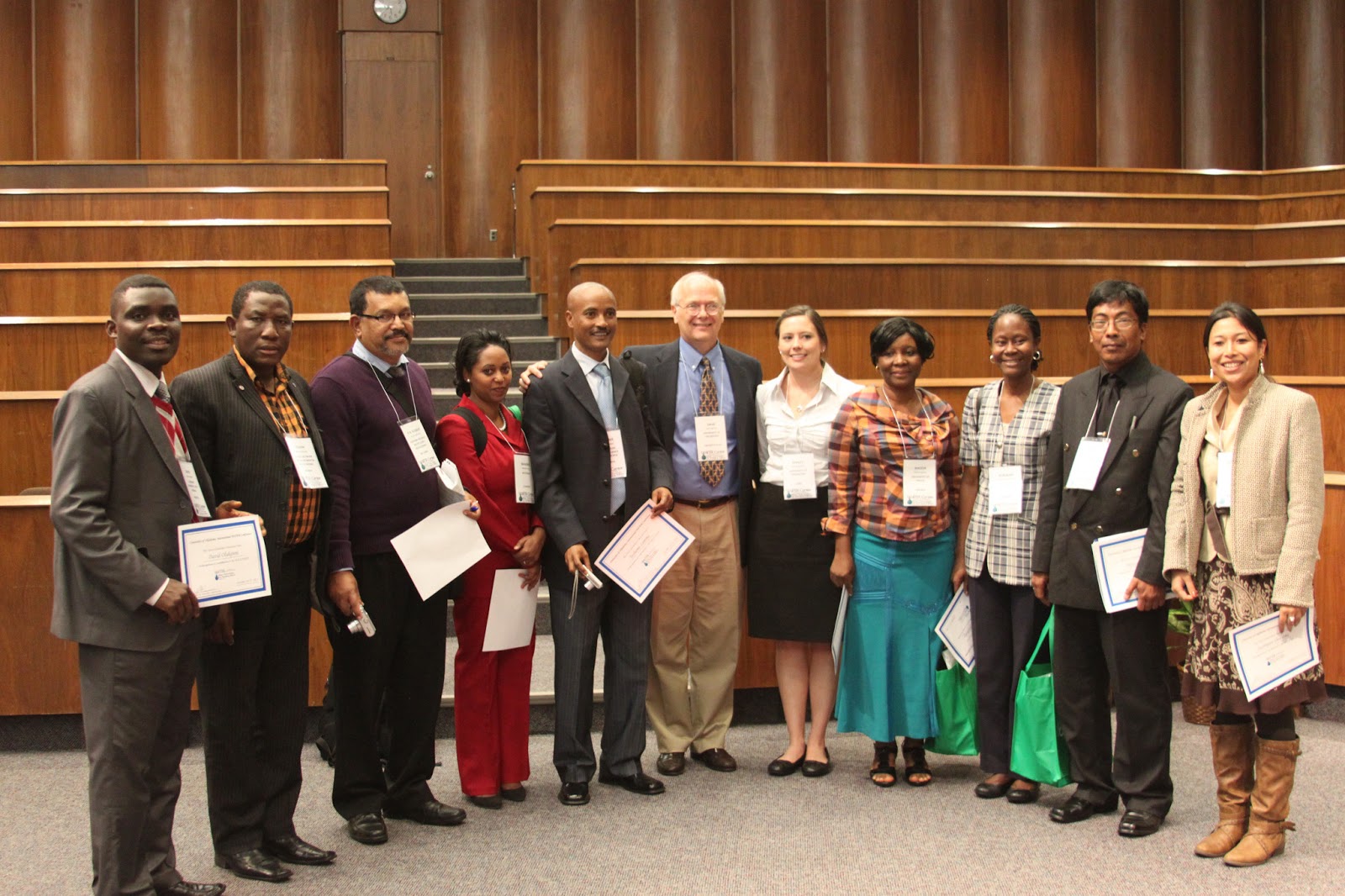
International travel scholarship recipients (2011 Conference), pictured with Dr. David Sabatini and Ashley Walker of the WaTER Center

The Conference will continue its tradition of K12 student involvement as well, drawing in students via its art and poster competition which was such a hit two years ago. As a bonus, this year's Conference will be attended by Deepika Kurup, the Discovery Education 3M 2012 Top Young Scientist Award winner, a high school student from Nashua, New Hampshire, whose winning project was on increasing the efficiency of oxidation used to disinfect drinking water in developing countries.

To register for the Conference, visit WaTER Conference Registration.

Friday, February 15, 2013

Call for Abstracts

The WaTER Technologies for Emerging Regions (WaTER) Center at the University of Oklahoma will host the Third OU International WaTER Conference and International Water Prize Award Ceremony on Sept. 23-25, 2013 in Norman, Oklahoma, USA. Abstracts, for oral presentations and posters on any topic related to water and sanitation issues in emerging regions, are due on March 15 (international developing countries) and April 1 (U.S. domestic and all other).

International guests make new friends at the 2011 WaTER Conference.
 Topical areas include, but are not limited to, the following:

•       Fluoride / arsenic mitigation systems
•       Appropriate drilling technologies
•       Novel WASH technologies
•       Drinking water treatment innovations
•       Ground water exploration/production systems
•       Treatment wetlands for water quality mitigation
•       Conservation and reuse technologies
•       Social entrepreneurship/microfinance
•       Cultural and behavioral change
•       Climate change effects on water resources
•       Educational initiatives in WaSH
•       Student service organizations
•       Role of NGOs and charitable organizations in WaSH


Guests at the Conference are treated to traditional Native American dance.

A limited number of international (developing country) travel scholarships are available!

Conference and workshop registration information is now posted and can be found here.

Ecological Engineering in Bolivia


Surrounded by mining, the mountainous region of Potosi, Bolivia, is plagued by extensive environmental contamination from past and current mining operations. One mountain alone annually discharges an estimated 161 tons of zinc, 157 tons of iron, and more than two tons of arsenic in addition to dozens of other toxic minerals, including cadmium and lead, through its water. Researchers from the University of Oklahoma have discovered a technique to remove pollutants from water that requires minimal labor costs and is powered by nature itself. After 15 years of testing, research has shown this passive water treatment method to be successful in as diverse geography as the flatlands of Oklahoma and the mountains of Bolivia. 

OU researchers measure water quality in mine drainage flows in Bolivia.


Improved water quality is clearly visible at the Tar Creek site in Oklahoma.


The passive water treatment system is created by engineering an ecosystem consisting of a series of filtering ponds. As the water moves through each specifically designed pond, a natural chemical or biological process removes certain contaminants as it slowly moves from one cell into the other before being re-released into natural waterways. “When the water reaches the last pond, it has gone from looking like orange, sediment-laden sludge to clear water,” said Robert Nairn, Associate Director for OU’s Water Technologies for Emerging Regions Center and director of the Center for Restoration of Ecosystems and Watersheds.

Bolivian highland villagers depend upon surface water for drinking and cooking.

The ecological filtering system requires less fossil fuel input and produces less pollution than traditional energy intensive water filtration technologies. “Since it is powered by the sun, wind and gravity, it requires minimal labor cost and only needs to be checked about once every three months,” said Nairn.
The passive water treatment system captures contaminated water from the mines, which flows through the series of constructed ponds for treatment. “The region gets less than 17 inches of rain per year,” Nairn said. “Much of the limited water is used for irrigation of staple root crops by the local farmers, resulting in contaminated soils and crops, posing substantial health risks.”


Dr. Bob Nairn, OU WaTER Center Associate Director, teaches courses in ecological engineering and wetlands science.


Building upon their experience in the Tar Creek, Okla., Superfund site, the researchers are engineering an ecosystem to treat polluted water in Potosi. The difference between the Tar Creek project and Potosi project is the extreme geographical conditions. Instead of Oklahoma flatlands, the team is working in a desert at 16,000 feet, which poses new challenges. “Massive water pollution is an issue that affects us all,” Nairn said. “If left untreated, the results are the same: unsafe living conditions and potential health risks. We learn from research in both developed and undeveloped countries to counteract this man-made threat with ecologically friendly solutions.”


Researchers present at GeoGen Conference

Four researchers with the WaTER Center - Dr. David Sabatini, Dr. Jim Chamberlain, Laura Brunson, and Anne Kroeger - presented at the GeoGen 2013 Conference in Addis Ababa, Ethiopia, Feb. 5-7. This conference, the first of its kind, focused on naturally-occurring water contaminants of geologic origin, primarily arsenic and fluoride. Participants from 15 countries were present to share research and dialogue about such topics as water treatment methods, health impacts and assessments, and alternative water source options that avoid ingestion of harmful contaminants.

Anne and Laura (first and second from right) share drinks and laughs with friends at the Conference banquet.
 
Conference participants were treated to an evening of Ethiopian dance and music.
Laura (PhD candidate, Environmental Engineering) presented on "Optimizing fluoride removal materials for drinking water in Ethiopia" while Jim (WaTER staff engineer) presented on "Alternative water sources in Cambodia: reaching the bottom billion". Anne (PhD candidate, Anthropology) presented a much-admired poster on her research, "The health effects of fluorosis in the Ethiopian Rift Valley", and Dr. Sabatini (WaTER Center Director) was an invited keynote presenter. His address was a case study of geogenic contaminant mitigation in the U.S., comparing three different-sized communities and their public water supply decisions.
Dr. Sabatini presents at the gathering of 85 participants.

Injera, made of teff flour, is a yeast-risen flatbread and the national staple of Ethiopia.
The GeoGen Conference was organized and co-hosted by EAWAG (Switzerland) and Addis Ababa University in Ethiopia. Sponsors for the conference included World Vision, the World Health Organization (WHO), and the Chemical Society of Ethiopia.

Building capacity in Africa

Zachary Flamig knew he wanted to be a meteorologist from the time that he was 8 years old. It was then that his hometown of Dallas got pounded by a massive hailstorm, one that showed the fury and the power of the "Nature of the Sky".  He got his B.S. and Masters degree here at OU, and decided to stay on and pursue a PhD, working under Drs. Yang Hong (of the WaTER Center) and J.J. Gourley. His research is to develop and fine-tune a high-resolution hydrologic model that can be used to predict flash-flood events both in the U.S. and abroad. The model can be calibrated and tested using historical flood data from previous decades.
Zac Flamig is a 2nd year PhD student in Meteorology.

Zac Flamig teaching classes this spring in Namibia and Rwanda.


Although his doctoral research is centered on U.S. applications, Zac has been called upon by NASA to help build human capacity for flood predictions in Africa. Agricultural populations in south-central Africa are extremely vulnerable to flooding events, because of both damage to food crops and inability to relocate to safer ground. Accurate flood prediction can save lives in both the near-term and longer term. Zac has taught hydrologic model courses in Kenya and Rwanda, and has assisted local personnel in validating models using GPS and ground measurements obtained by helicopter, boat, and on foot. In addition, he is helping Namibian scientists create their own base map to be utilized in flash-flood predictions.


Pictures of the Okavango River in north Namibia.

While at OU, Zac has been active in the amateur radio club (served as president for 3 years), is seeking to get his aviation license, and is an avid storm-chaser in a region of the country where storms can be hugely entertaining! His first big view of a tornado was in the Texas panhandle in 2007. Zac is careful to point out that skipping class to chase a storm is specifically against school policy. One wonders why such a policy would ever have to be stipulated in the first place...?....