Monday, August 5, 2024

RSVP for the International Water Symposium, Sep 4, 2024


Water is the essential ingredient for life on earth. From Arizona to Bangladesh to Tanzania, people are challenged to find and secure safe and ample water supplies for the needs of their communities. Thankfully, both researchers and practitioners across the globe are daily dedicating their lives to helping others secure this safe water supplies.

Children and their water supply in a South African village.

The OU WaTER Center is committed to recognizing and honoring those individuals, acting alone or as leader of an organization, who have made significant contributions in the field of water resources (quantity) or sanitation and other health aspects (quality) of water, particularly for the benefit of disadvantaged communities in rural or remote regions. The International Water Prize is a biennial award sponsored by the WaTER Center at OU and made possible by generous gifts from alumni, friends, and the OU administration. The Prize consists of a $25,000 cash award and a glass trophy developed by a local artist. The Prize is believed to be the first and largest prize dedicated to water supply, water resources, and/or sanitation in emerging regions.

A panel of experts discusses critical water issues
at the 2019 OU International Water Conference.

A panel of 5 water experts will convene in Norman to select the seventh OU Water Prize winner. Their selection will be announced at a formal Symposium on the evening of September 4 at the Atrium of the National Weather Center in Norman, OK. This event will include a banquet, brief talks by each of the jurors on their water expertise, a panel discussion, and the announcement of the new Prize winner. The winner will then give the keynote address at the following year's International Water Conference in Norman, OK.

This year's Symposium will be held at the beautiful Atrium
of the National Weather Center (NWC) in Norman, OK.

The event is free and open to the public, but registration is required.
Please register here.


Tuesday, July 2, 2024

The newest OU International Water Prize winner will be selected at the next Symposium on September 4, 2024


The actual Water Prize is a blown glass of the world
in the shape of a water droplet.

The purpose of the OU International Water Prize (“the Prize”) is to recognize and honor an individual, acting alone or as leader of an organization, who has made significant contributions in the field of water resources, sanitation, or other aspects of water security, particularly for the benefit of disadvantaged communities in rural or remote regions. The Prize is a biennial award sponsored by the WaTER Center and is made possible by generous gifts from alumni, friends, and the OU administration. It consists of a $25,000 cash award and a glass trophy developed by a local artist. Past winners and Prize details can be found on the website. 

The Prize is believed to be the first and largest prize dedicated to water supply, water resources, and/or sanitation in emerging regions. The Directors of the WaTER Center, with input from the WaSH and water resources community, select a panel of jurors, comprised of 5-6 qualified specialists who work in the area of the field of WaSH and water security as it relates to water supply and resource planning, particularly for emerging regions. These jurors come to the OU campus in the Fall to select a new awardee. Each juror is responsible for nominating one person for the Prize. After a full day and a half of deliberations, the jurors select their top candidate. The new Prize winner is announced at an evening Symposium, an elegant affair which includes a delicious banquet and short presentations from each of the jurors.

The Symposium banquet provides a beautiful context
for the announcement of the newest Water Prize winner.

Dawn Martin-Hill is awarded the 2022 OU International Water Prize!


Dawn Martin-Hill gives the Keynote Address
at the 2022 International Water Conference banquet in Oklahoma City, OK

Dawn Martin-Hill is a storyteller, because it is in stories where the truth lies. She tells one story of leading a water ceremony out on the west coast of the U.S. One participant brought a pottery bowl that was engraved with “Water is Life” in many different languages. That bowl is a symbol of Dawn’s lifework – to honor and celebrate the sacramental gift that water is to all peoples using the stories and myths of her culture, the Haudenosaunee peoples of Canada’s Six Nations of the Grand River. The two-row wampum belt is another symbol that expresses a journey of two cultures who travel down the river together, side by side, without trying to steer one another. Surrounded by the Great Lakes, Dawn’s tribal culture is defined and nourished by freshwater. She says that “our entire way of life is governed by water. It is spiritual, it is cultural, it is our identity. When you take that away from us, you are literally taking away our culture.”  

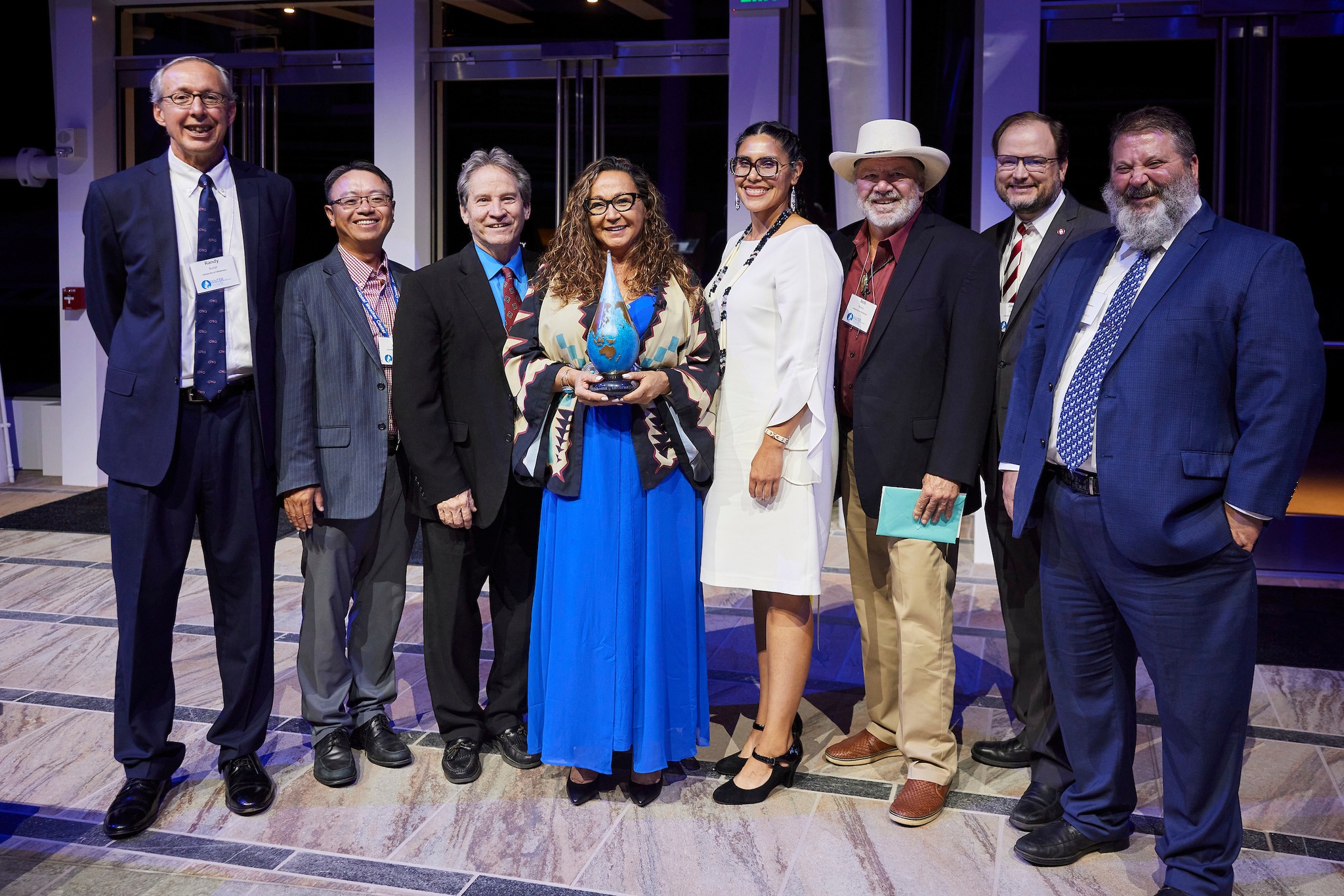
Dr. Martin-Hill receives her award surrounded by the WaTER Center Directors
along with Tana Fitzpatrick, Director of the Native Nations Center at OU.

Traditional indigenous knowledge is relayed through oral tradition, primarily from stories, arts, crafts, and ceremonies, all done in the indigenous language.  Under colonization, the residential schools outlawed the indigenous language, and yet indigenous knowledge about water and ecology is embedded in the native language. When the language is lost, so is the indigenous knowledge.  Thus, Dawn’s integrated teams of elders, youth, biologists, scientists, and engineers present their work in bilingual format. 

Tuesday, February 15, 2022

Call for Abstracts - NEW Deadline June 1, 2022

 Call for Abstracts Deadline June 1, 2022

The OU Water Technologies for Emerging Regions (WaTER) Center is soliciting abstracts for poster and oral presentations for the OU International WaTER Conference to be held virtually on September 26-27, 2022.


Abstracts for oral or poster presentations dealing with issues in the topical areas listed below are invited.  Subject matter areas include engineering, hydrology, water quality, meteorology, anthropology, sociology, social entrepreneurship, legal issues and related areas. Interested participants should submit an abstract of no more than 500 words to the conference Selection Committee by April 30, 2022. 


The abstract should include a succinct but descriptive title of the proposed presentation, and name, affiliation, and contact information (including email) of all authors.  The abstract should identify the topic of the proposed presentation and should include a brief description of the research, innovation, or project, and discuss the significant results of the efforts and conclusions or recommendations drawn from the study.


Drs. David Sabatini and Jim Chamberlain
give remarks at the 2015 Conference.


Critical Water Issues in Today’s World


Abstracts will be especially welcomed in the following targeted areas:

  • WASH Interventions
    The WaSH (water, sanitation and hygiene) sector includes all research and activities relative to the improvement of health and well-being by the proper separation of sanitation and clean water access. Interventions that improve hand-washing and other hygienic behavior are relevant, as well as household and community-level implementations of safe water storage, water treatment, and improved sanitation technologies.

  • Water Challenges for Underserved Populations
    Water availability, wastewater management, and water-related social justice issues for Native Americans, First Nations, or other underrepresented communities.

  • Aging Water and Wastewater Infrastructure Systems
    Identification, removal, and replacement/restoration of water and wastewater infrastructure systems in both developing and developed regions.
  • Wastewater-based Epidemiology
    Public health applications of using wastewater surveillance for monitoring pathogens and chemicals in a variety of locales. Examples include pathogens such as SARS-CoV-2 and/or chemicals such as pharmaceuticals, illicit drugs, or human-health biomarkers.
  • Ecological Engineering and Engineering with Nature
    Design and analyses of Natural Infrastructure (NI) for water quality improvement, water management, and other environmental benefits. Broad-scale Nature and Nature Based Solutions (NNBS) and site-specific treatment wetlands, passive treatment systems, and related sustainable ecosystem-based technologies.

  • Advances in Drought Monitoring, Modeling, and Prediction
    New tools and approaches that address the complex factors associated with drought from local to global scales, including (1) observations strategies focused on drought, (2) the temporal evolution of drought from flash drought to decadal and beyond, (3) the drivers of drought onset, development, intensification, and decay, (4) drought impacts to agriculture, water resources, ecosystem function, and human systems, and (5) research to operational tools that enhance drought prediction.

  • Climate Change and Hydrology Extremes
    Climate change impacts on water scarcity and potential flooding and the use of hydrologic and global climate models to predict areas of future water extremes in the US and abroad to provide a scientific basis for water resource planning.
  • Natural Hazards
    State-of-the-art discussion of impacts of natural hazards on freshwater resources, such as a wildfire burn areas and hurricane flooding. Current challenges and the impacts of water quantity or water quality to fresh water sources in inland riverine environments, lakes and reservoirs, with a special interest in highlighting needs and opportunities for cross-disciplinary collaboration.

  • Other
    Presentations addressing subject matter related to the conference theme are also invited.


Submit your abstract here


For more conference details, go to WaTER.ou.edu


Ada Oko-Williams is shown with travel scholarship recipients
from the 2013 International Water Conference.


Saturday, September 18, 2021

Final RSVP and spotlight on three WaTER Prize jurors

 Water Security and Equity in a Changing Climate

The International WaTER Symposium is online this year - this Tuesday, Sep 21, 7:00 - 8:30pm

Please RSVP here, and you will be forwarded a Zoom link upon registration:

RSVP

INTERNATIONAL WATER SYMPOSIUM 

TUESDAY, SEPTEMBER 21 (via ZOOM) 

7:00-7:15 PM    Welcome and opening remarks

7:15-7:55 PM    Short presentations by jurors on water projects and global water issues

7:55-8:20 PM    Question & Answer session with jurors on relevant challenges to water security

8:20-8:28 PM    Announcement of the 2022 International Water Prize winner! 

8:28-8:30 PM    Thank-you and save the date for the next WaTER Conference

SAVE THE DATE

OU International WaTER Conference

September 26-28, 2022 | Norman, OK 


Dr. Ana Barros is a South African-born American civil and environmental engineer currently serving as the Department Head of Civil and Environmental Engineering at the University of Illinois. She is an Elected Fellow of the American Association for the Advancement of Science and in 2019 she was elected to the National Academy of Engineering for "contributions to understanding and prediction of precipitation dynamics and flood hazards in mountainous terrains". Ana attended the Faculty of Engineering of the University of O’Porto where she obtained a summa cum laude Diploma in Civil Engineering and a M.Sc. degree in Ocean Engineering in 1988 with a thesis focusing on numerical modeling of sediment transport in estuaries and coastal regions. In 1990, Dr. Barros completed and M.Sc. degree in Environmental Science Engineering at the OHSU/OGI School of Science and Engineering. She earned a Ph.D. in Civil and Environmental Engineering from the University of Washington, Seattle in 1993. 


Dr. Aondover Tarhule is the Provost and Vice President for Academic Affairs and for Illinois State University. Prior to this recent appointment, Dr. Tarhule served as Vice Provost and Dean of the Graduate School at Binghamton University, part of the state universities of New York. While at Binghamton, he has facilitated the creation of new degree programs, developed new international partnerships, and implemented several major innovations to data and workflow software. 
A physical geographer, Tarhule’s work on climate impacts on water scarcity and security has been featured in National Geographic and Nature. His scholarly research has appeared in prestigious international journals and book chapters. His efforts as principal investigator (PI) or co-PI have resulted in more than $5 million in grants from such agencies as the National Science Foundation, the United States Agency for International Development, the National Institute of Health, and the United States Geological Survey.


Dr. Upmanu Lall is the Director of the Columbia Water Center and the Alan and Carol Silberstein Professor of Engineering, and the Chair of the Dept. of Earth & Environmental Engineering at Columbia University. He has broad interests in hydrology, climate dynamics, water resource systems analysis, risk management and sustainability. Upmanu’s current research covers 3 major initiatives that are developed through the Columbia Water Center. The Global Water Sustainability Initiative addresses global water scarcity and risk. The Global Flood Initiative is motivated by the need to predict, mitigate and manage floods at a global scale recognizing their climate drivers, and supply chain impacts. America's Water seeks to develop sustainable water management and infrastructure design paradigms for the 21st century recognizing the linkages between urban functioning, food, water, energy and climate. These programmatic initiatives are backed by research on systems level modeling of hydrology, climate, agronomy and economics.

These three jurors will be serving alongside the other two jurors, spotlighted in a previous blog - Merrell-Ann Phare and Callist Tindimugaya. The five panelists are eminently qualified to select the next recipient of the OU International WaTER Prize!

Tuesday, September 14, 2021

RSVP and schedule for the Water Symposium - September 21, 2021

Water Security and Equity in a Changing Climate

The International WaTER Symposium is online this year - one week away!

Please RSVP here, and you will be forwarded a Zoom link upon registration:

RSVP


Eric Stowe receives the 2017 International Water Prize
from the current OU President Joe Harroz.

A general outline schedule of the event follows:

INTERNATIONAL WATER SYMPOSIUM 

TUESDAY, SEPTEMBER 21 (via ZOOM) 

7:00-7:15 PM    Welcome and opening remarks

7:15-7:55 PM    Short presentations by jurors on water projects and global water issues

7:55-8:20 PM    Question & Answer session with jurors on relevant challenges to water security

8:20-8:28 PM    Announcement of the 2022 International Water Prize winner! 

8:28-8:30 PM    Thank-you and save the date for the next WaTER Conference


SAVE THE DATE

OU International WaTER Conference

September 26-28, 2022 | Norman, OK 


Tuesday, August 10, 2021

RSVP and spotlight on two jurors for the Water Symposium - September 21, 2021

We are only six weeks away from our next Water Symposium in which a group of five distinguished jurors will select the next recipient of the International Water Prize! As part of our preparation, we want to share some information on each of our jurors. We begin with Merrell-Ann Phare and Callist Tindimugaya.

Merrell-Ann Phare is a leading proponent of water equity for indigenous Canadians.

Merrell-Ann is a Canadian lawyer with specialties in water rights and water law; serves on the International Joint Commission (U.S. and Canada – Boundary Waters agreement, 1909) lawyer, writer, strategist, negotiator, and relationship-builder who worked extensively in and with indigenous organizations on environmental, land, water, rights, and governance issues. 

She is the author of the book “Denying the Source: The Crisis of First Nations Water Rights” and co-author of “Ethical Water”. She is a member of Smart Prosperity, the Forum for Leadership on Water and is a recipient of the Clean 50 Award. She is legal counsel and advisor to several First Nation governments and regularly speaks on governance, water, and rights issues. Merrell-Ann is also the co-host of "Porcupine", a smart and entertaining podcast on reconciliation between indigenous and non-indigenous Canadians.

Dr. Tindimugaya has helped manage and address the challenges of transboundary water resources.


Dr. Callist Tindimugaya is a Water Resources Specialist that has been working with the Ministry of Water and Environment in Uganda for over 30 years. Currently, he is the Head of the Department for Water Resources Planning and Regulation with overall responsibility for ensuring sustainable and equitable utilization and protection of water resources of Uganda.  Callist has represented Uganda for over 15 years in international and transboundary water resources programs and initiatives such as the Nile Basin Initiative (NBI), Inter Government Authority on Development (IGAD), and UNESCO’s International Hydrological Program. He is also the Regional Coordinator of the Nile Basin Capacity Building network, established for building capacity in Integrated Water Resources Management.

Callist received his doctoral degree from University College London, where he studied the movement and storage of groundwater in Ugandan aquifers.  His research assessed two productive aquifers using environmental tracers and aquifer responses to hydraulic stress.  A better understanding of the relationship between the geomorphology and hydrogeology of deeply weathered environments can help set realistic targets for water security in groundwater-dependent communities

--------------

The seventh OU International WaTER Symposium will be held on Tuesday evening, September 21, 2021, 6:30 - 9:00 pm in the Molly Shi Boren Ballroom of the University of Oklahoma. In the evening's program, which includes a banquet dinner, the five jurors will share some of their own research and experiences in the field through short presentations and a panel discussion on pertinent water issues of our day.

The event is free and open to the public. Please RSVP here.

Dr. Robert Nairn addresses the 2018 Water Symposium and Prize announcement.

International Water Prize Announcement and Symposium

TUESDAY, SEPTEMBER 21, 2021 | 6:30 - 9:00 PM

OKLAHOMA MEMORIAL UNION

Monday, May 10, 2021

International WaTER Symposium to be held September 21, 2021 - Save the Date!

Save the Date! - The seventh OU International WaTER Symposium will be held on Tuesday evening, September 21, 2021, in the Molly Shi Boren Ballroom of the University of Oklahoma. The primary purpose of the Symposium is to select and announce the next winner of the OU International Water Prize.

During the few days prior to the Symposium, a group of five distinguished jurors will each nominate an individual who is making a real difference in the hydrology, water security, and WaSH (water, sanitation and hygiene) sectors, especially for communities in need. After much discussion and some debate, these jurors will complete their deliberations, select a Prize winner, and announce the Prize winner at the Symposium event. In the evening's program, they will also share some of their own research and experiences in the field through short presentations and a panel discussion on pertinent water issues of our day.

Dr. David Sabatini addresses the Prize Banquet
at the 2019 International Water Conference

Martha Gebeyehu, 2019 Prize winner, is seen here
with family and friends on the night of the 2019 banquet


The Prize winner will come to campus next year (2022) for the International Water Conference, where she/he will give the Keynote Address and accept their Prize at the formal Banquet. This Prize is believed to be the first and largest prize dedicated to water supply, water resources, and/or sanitation in emerging regions.

Below is a brief introduction of this year's Prize jurors:


Ana Barros (University of Illinois - Department Head of Civil Engineering)

Ana has interests in hydrology, hydrometeorology and environmental physics with a focus on water-cycle processes in the coupled land-atmosphere-biosphere system, particularly in regions of complex terrain. Dr. Barros has expertise in the critical area of water security and environmental sustainability, with emphasis on the study of water cycle processes taking place in the land-atmosphere-biosphere system. 


Upmana Lall (Columbia University)

Dr. Lall is the Director of the Columbia Water Center and Editor-in-Chief of Water Security journal. He also leads the Global Water Sustainability Initiative which addresses global water scarcity and risk. The Global Flood Initiative is motivated by the need to predict, mitigate and manage floods at a global scale while recognizing climate drivers and supply chain impacts.

Merrell-Ann Phare (Phare Law Corporation, International Joint Commission)

Merrell-Ann is a Canadian lawyer with specialties in water rights and water law. She serves on the International Joint Commission (U.S. and Canada – Boundary Waters agreement, 1909). She is a lawyer, writer, strategist, negotiator and relationship-builder who has worked extensively in and with indigenous organizations on environmental, land, water, rights and governance issues. She has authored or co-authored two books on water ethics and the water rights of First Nations.


Aondover Tarhule (Illinois State University)

Dr. Tarhule has studied the impact of climate change on crop yields in the Niger River basin, the effects of particulate air pollution on public health in Burkina Faso, and the usage of satellite data to improve the water security index for regions in Africa. His work on the impacts of climate change on water scarcity and security has been featured in National Geographic and Nature.


Callist Tindimugaya (Uganda - Ministry of Water and Environment)

Dr. Tindimugaya's career has focused on groundwater protection and management in Africa. He has published articles in journals of hydrogeology which describe the importance of groundwater resources in the threats of urbanization, industrial development, agricultural and mining activities, and poor sanitation practices.


We look forward to welcoming these jurors to our lovely OU campus in the Fall!

More detailed information on ways to participate in the Symposium will be coming later this summer.

Friday, December 4, 2020

OU WaTER Symposium planned for Fall 2021

The pandemic has changed the way many of us live and work and go to school. But one thing has not changed - people across the world still need clean water for drinking and hygiene, and proper sanitation, perhaps now more than ever. Frequent hand washings are a part of daily life in the developed world, but an estimated 790 million people - 11% of the world's population - lack access to clean water and are thus more susceptible to infectious diseases such as Covid 19. 

The mission of the OU WaTER Center also has not changed - to promote peace by advancing human development through sustainable water and sanitation for all. But we are not alone. There are many men and women across the globe who are doing amazing work in the sharing of this mission. 

Dr. Robert Nairn addresses the 2018 Symposium participants at the banquet
in which the next Prize winner is announced. 

The purpose of the OU International Water Prize is to recognize and honor an individual, acting alone or as leader of an organization, who has made significant contributions, either through research or teaching or service activities, in the field of water supply, water resources or sanitation, particularly for small and impoverished villages/communities in rural or remote regions. This next Water Prize will be awarded to someone who has made this contribution in the field of hydrology and/or water security (HWS) for the benefit of disadvantaged communities. 


Martha Gebeyehu (center), sanitation expert in Ethiopia, is the winner of our
2019 International Water Prize.

Martha receives her Prize at the formal banquet that was part of the
2019 International Water Conference in Norman, Oklahoma.

Every two years the WaTER Center assembles a panel of 4-5 jurors who are themselves leaders in the fields of water, sanitation and water security. These jurors each nominate an individual who is making a real difference in the WaSH (water, sanitation and hygiene) and water security sector. 

We are pleased to announce that the Prize jurors for the next OU International Water Prize are:

  • Ana Barros, University of Illinois 
  • Upmanu Lall, Columbia University
  • Aondover Tarhule, Illinois State University
  • Callist Tindimugaya, Ministry of Water and Environment, Uganda
These jurors will complete their deliberations, select a Prize winner, and announce the Prize winner at next Fall's Symposium. At this exciting event, they will also share some of their own research and experiences in the field.

The biennial Prize consists of a $25,000 cash award and a glass trophy developed by a local artist. The winner comes to campus the following year (2022) for the International Water Conference, where she/he will give the Keynote Address and accept their Prize at the formal Banquet. This Prize is believed to be the first and largest prize dedicated to water supply, water resources, and/or sanitation in emerging regions.

Stay tuned for the announcement of date for our Fall 2021 WaTER Symposium!


Thursday, December 3, 2020

SPOTLIGHT ON A PARTNER - Covid response from the Sisters of the Sacred Heart of Jesus

Each June in normal years, the OU WaTER Center supports staff and students to spend a month in Gulu, Uganda, working on a project or two in support of Sr. Rosemary Nyirumbe and her Catholic sisters. Needless to say, the year 2020 has not been a normal year! But the work of the Sisters of the Sacred Heart of Jesus continues nonetheless.

Sr. Pasqua Binenanena oversees the liquid hand soap that is being made and distributed
by staff and orphans.

The orphan students are sewing face masks and making liquid hand soap to distribute to people in great need during this time of pandemic. In addition to residents of northern Uganda, there are hundreds of refugees crossing the border each day from South Sudan and the DRC. These families need food and clean drinking water, of course. But they also need proper hygiene for protection against the coronavirus pandemic. Uganda's Covid rate is 0.8 per 100,000, far less than the U.S., but the 14-day trend is upwards and the country's health care system might become easily overwhelmed if the rise continues. In addition, there is the ever-present concern about malaria which sickens people and reduces the number of constructive work days. 

Ugandan refugee families wait for need supplies during a time of crisis.

There are around 100 orphan girls who currently live at Saint Monica's Tailoring School for Girls in Gulu. (Because of Covid, the government has strict regulations on housing density.) The orphanage began as a home for girls who had been enslaved by Joseph Kony's army of rebels during the Ugandan civil war of the 1980s. Sr. Rosemary Nyirumbe gave the girls a safe place to live while they also earned valuable skills such as sewing, cooking and hair styling. For her humanitarian work, Sr. Rosemary was honored as one of Time magazine's 100 Most Influential People of 2014. 

The Sisters of the Sacred Heart of Jesus are donating much-needed items to the Congolese refugees who are escaping violence and fleeing into Uganda.

Dr. Ann Huynh is a physician in Austin, Texas. Her Foundation, Universal Angels Network, has been very supportive of Sr. Rosemary and her Sisters. This Foundation paid for a water tank last year and continues to support the Sisters through paying for medical training scholarships and providing for mosquito netting and materials for face masks and hand soap. 

Young people are making hand sanitizing soap to distribute to Congolese refugees and others in need during the pandemic. 

According to Sr. Pasqua Binenanena, about 2500 refugees passed into Uganda from DRC in the three months of summer alone. Uganda is known as the friendliest country to refugees in Africa. But even as it is trying to keep its borders closed due to the pandemic, families still find ways to escape the violence in their own country to a land that welcomes them, albeit somewhat reluctantly. Sr. Pasqua says that "their problems have been compounded by the lack of basic things like food. Refugees anywhere are a very vulnerable group because they are usually very exposed in their host countries away from home and they need to be protected."

Sr. Rosemary Nyirumbe is seen here at Saint Monica's Tailoring School in Gulu.

Because of the lockdown back in late spring, Sr. Rosemary herself has been "stuck" in the U.S. where she has been earning an advanced degree at the University of Oklahoma. She meets weekly with her staff back in Uganda via virtual meetings and sends her love back, along with whatever donations she can raise for them here from generous friends and benefactors. 

You can support the work of Sr. Rosemary and the Sisters of the Sacred Heart of Jesus by giving to the Sewing Hope Foundation.


AWIA presents deadlines for water supply plans

In a changing climate and a rapidly expanding population, water security will not happen without careful planning. And it won’t be achieved overnight. Planning for water security includes planning for unforeseen circumstances, or hazards, whether from natural disasters or malevolent acts. These hazards could include a sudden natural catastrophe, such as a tornado, hurricane, earthquake, or flood. The natural event might also be of longer-term, such as drought or impacts from climate change. There is also risk from human-induced events, both unintended and intentional. These include accidental spills as well as vandalism or terrorism (malevolent acts). 

Water treatment plant in Geneva, Illinois.

The America's Water Infrastructure Act (AWIA) of 2018 was passed by Congress to ensure that community water systems had plans in place that would help them respond appropriately to such hazardous events. The law required all large and medium-sized water systems to develop risk and resilience assessments (RRA) and emergency response plans (ERP). Any system that serves more than 3,300 people must certify that these plans are in place. 

The process involves four discrete steps:

  • Step One: Conduct a risk assessment (RA). The EPA has developed a tool – Vulnerability Self-Assessment Tool (VSAT 2.0) – to assist utilities in conducting their own risk and resilience assessment. With this tool, the utility can identify the highest risks to mission-critical operations and find cost-effective measures to reduce these risks.  This assessment must be completed by a certain deadline (in the year 2020) and then reviewed, updated and re-certified every 5 years.
  • Step Two: Identify some strategies to build resilience. The first step has helped the managers prioritize hazards based on likelihood and consequences. For example, the team may decide that flooding, wildfires and water supply management are the biggest concerns. Then, potentially vulnerable assets are chosen, including aquifers, buildings, data acquisition systems, drinking water treatment plant, and forested lands. The manager selects which of these assets are most vulnerable in his/her system. The team then presents a list of strategies based on the highest priorities of their water system.
  • Step Three: Develop an emergency response plan (ERP). This plan utilizes and builds upon the risk assessment and selection of resilience strategies already completed. The ERP describes the utility’s strategies to prepare for and respond to incidents, whether natural or human induced. These may be as small as a main line break or localized flooding. Or they may be larger, such as a hurricane, power outage, or a cyber-attack. This plan is due six months after certification of the risk assessment (RA) plan.
  • Step Four: Monitor the system. Monitoring activities should focus on both water quality surveillance and security monitoring. Water quality surveillance is done at the treatment plant and in distribution systems. Monitoring is done at various locations and for various parameters. ERP will highlight the key parameters. Enhanced security monitoring uses advanced security equipment and communication systems.

The development of a risk assessment plan involves both an on-site assessment
and meetings with key plant personnel. 

The OU WaTER Center, along with the Oklahoma Water Survey, has personnel that are willing to help low-resource communities develop these plans. This exercise is part of our mission to both educate students in the professional practice of water security and assist rural communities (emerging regions) in need. The deadline for small utilities (3,301-49,999 people) to complete their risk and resilience plan (Step One above) is June 30, 2021.

Wednesday, October 14, 2020

Testing campus wastewater for Covid-19 virus

Sewage testing has been used in the U.S. for detection of other diseases in the past, such as polio. Since about 80% of households are connected to a central sewerage collection, in this time of pandemic it is reasonable to conduct sewage surveillance in order to detect the SARS-CoV-2 virus which causes Covid-19 illness. The virus is shed in the feces of individuals even before they start showing symptoms. 

A student worker is collecting a sewage sample on the OU campus to test for the coronavirus.

Dr. Jason Vogel, a WaTER Center co-director and Director of the Oklahoma Water Survey, has been collecting sewage samples on the University of Oklahoma (OU) campus for early detection of the virus. The samples are collected downstream of campus student housing during after-lunch hours (12 noon to 2 pm) when the wastewater flow rate is highest. 

Student workers collecting sewage samples follow strict health and safety protocols so that they themselves will not get infected.

OU microbiologist Associate Professor, Bradley Stevenson, is heading the program and studies of the samples, which typically have a 24-hour turnaround time. Dr. Stevenson says that “this (method) definitely can be an early warning....What we’re doing is actually monitoring the levels of COVID-19 in the wastewater,” Stevenson said. “When an individual has COVID-19, they shed the virus through their feces and we can actually detect that.” This is a method that can both show trends over time and provide an early warning system, about 3-7 days prior to a normal detection protocol using onset of symptoms. In addition, the RNA laboratory testing is a non-invasive form of detection as compared to clinical testing. 

Private water providers in rural Ghana

How well does a small privately-owned business provide safe water to a rural community in west Africa? What are the benefits as well as the challenges? These are the questions that led to Philip Deal’s research in the ecologically-diverse country of Ghana. 

Hand pumping of water from a drilled borehole is still a very common method of water acquisition in Ghana.

Governments and NGOs across the world have observed countless handpumps and piped systems falling into disrepair, despite billions of dollars of investment into the water, sanitation, and hygiene (WaSH) sector. In opposition to this challenge, Water4 (an NGO based in Oklahoma City) set out to develop a sustainable model of building, operating, and maintaining safe water enterprises through their Numa water delivery kiosks. These kiosks became the product of a private water service company, Access Development (AD), in Ghana, West Africa. 

The water delivery system pumps water to a tank using solar power, disinfects the water with UV and chlorine disinfection, and supplies water to a kiosk where it is sold to local villagers. The borehole is owned by the community, but the pump and treatment center are owned by AD. Customers ‘pay‐to‐fetch’ vendors for their water with cash - 0.20 GHS per 18 L - equivalent to less than a cent per gallon.

Numa piped system network.

This water delivery kiosk provides clean water to Ghanaian villagers for a small fee


The goals of the water delivery system are to:

increase the reliability and functionality of the systems,

reduce the time needed to respond to breakdowns, and 

increase the revenue for these water systems so as to provide more long-term management.

Customers ‘pay‐to‐fetch’ vendors for their water with cash - 0.20 GHS per 18 L, equivalent to about 3 cents, less than a penny per gallon.

Private water service delivery is a result of a partnership between the University of Oklahoma, Water4, and Access Development. Pictured (left to right): Dr. David Sabatini, Mr. Wellington Amankwa, Dr. Philip Deal, Mr. Philip Aratuo

Ghana is a water-rich country and was found to have a sustainable supply of groundwater to meet domestic water supply. However, more mechanized drilling would be needed to make this water available to more people. 

Philip discovered that Access Development was giving equal or superior service to its customers, both poor and rich, compared to traditional water systems. Water had significantly better quality and was consistently available throughout the year. Yet, only about 35% to 40% of the population was using Numa water. With ongoing competition from free alternatives and seasonal challenges of affordability, customers would not always choose to use Access Development’s water service. Low residual chlorine for secondary disinfection was also found to be an area for improvement.


Water queue in Ghana observes social distancing during the pandemic.

As of the Fall of 2020, Access Development has grown to serve almost 90,000 people. The private company has plans to expand to more districts in Ghana in 2021, while other partners in Sierra Leone and Zambia are growing rapidly as well. Philip is now the Director of Community Engagement at Water4, where he is able to continue serving and supporting safe water enterprises in 15 different countries.
 A kiosk vendor is happy to serve you!


Building a wave-powered water pump in Tanzania

John Makonda lives in Geita, Tanzania, just south of Lake Victoria. Since Lake Victoria is the largest lake in Africa, many view the lake as an economic resource or a local recreation spot. However, John Makonda sees the lake as an experimental playground for the testing of his new wave-powered water pump.

John Makonda is testing his water pumping device on magnificent Lake Victoria.

Beginning in 2014, John has dedicated himself to the careful design and development of the pump which utilizes the upward and downward motions of a buoy connected to a lever in order to pump water as if it were a hand pump being operated by an invisible hand. The following sketches exemplify John’s attention to detail and his well-thought-out design.

Sketch of original design - Leonardo da Vinci would be proud!


These sketches are examples of John's creative impulse.

Since then, John has been able to build a prototype that shows promising results. Without schooling nor training, John gracefully manipulated the concepts of buoyancy, pressure head, and hydraulics in his invention which could prove to be extremely useful in the development of new water distribution systems. Since John’s pump is powered by the constant rise and fall of Lake Victoria, this could significantly decrease the cost and energy required to pump water from the lake to surrounding communities. Increasing populations in not only Tanzania, but Uganda and Kenya, will further expose the significance of John’s wave-powered water pump as the demand for potable drinking water rises.


John builds efficient cookstoves in his outdoor workshop, alongside a treadle pump.

Many who have come before John have tried to harness energy from the visibly powerful waves of the ocean with the likes of underground turbines. However, John Makonda takes a different approach, reminding us once again of the power of innovative thinking. His hard work and dedication will bring forth a new technology that can then be utilized by communities in search of a cost and energy efficient method of pumping freshwater inland.

John Makonda is a designer and innovator of appropriate technologies in central Africa.

Well done, John, and keep up the good work!


Tuesday, October 13, 2020

SPOTLIGHT ON A PARTNER: Marc and Ann Hall - still changing lives in Cambodia

The WaTER Center was first introduced to Marc and Ann Hall back in 2010 when this young married couple came to give a talk on campus about the life they chose to live in Cambodia. Cambodia is a beautiful land with a people who welcome visitors with a smile. But the country has also been struck with war and corruption resulting in illiteracy, lack of water and sanitation, and disease. These are the challenges that Marc and Ann work to overcome, with the help of Resource Development International - Cambodia (RDIC), as together they create and implement creative solutions for drinking water in the home and in the communities. 

RDIC ceramic water filters are built onsite and distributed to villagers, along with soap and illustrated hygiene information. 

The core of the RDIC strategy is built on local relationships with the Cambodian people. Team members and their families live in the villages and get to know the local people. By doing so, personal bonds are created and friends are made. From these friendships, various projects are implemented to serve the immediate community that the team lives in. While gardening and raising animals as well as working side by side and teaching friends in the villages, the team is able to meet immediate needs while education takes place. 


In pre-pandemic days, Ann Hall shares both her nursing skills and her faith with the Cambodian women.

On a larger scale, the community is served by technology improvements. When the group is asked to help install a water system at a school, or build toilets or sinks, they take the opportunity to offer an education program to the schools as well. This adds an additional personal touch.

Marc Hall instructs a worker at the RDIC ceramic water filter factory in Cambodia.

On the national level the RDIC studio produces TV and radio programming that is released on national television, radio and into the local marketplace. And on the international level, RDIC relies on help from individuals and groups who volunteer from abroad. During these short term trips many people understand and commit to the vision RDIC has developed. In fact, many of the current full-time RDIC staff joined RDIC after a short term trip to Cambodia.


The Covid pandemic has reached remote villages in which RDIC's teams are active, highlighting the need for masking and social distancing.

Mark and Ann are driven by both their love for the Cambodian people and the desire to share their faith in Christ. The couple leads prayer sessions and prepares teams to teach in both the schools and in the homes. Using her training as a nurse, Ann has treated many Cambodians who suffer from waterborne diseases and malnutrition. Much of her work is doing health and hygiene education regarding hydration and nutrition, so essential to these villagers with limited access to medical resources. In past years, the WaTER Center has sent both graduate and undergraduate students to work with RDIC on various projects, including the mitigation of arsenic-contaminated waters and the construction of ferrocement rainwater tanks. 


Ann and Marc Hall are holding a precious newborn baby in Cambodia.